Retaining Wall Sunshine Coast
Retaining Walls Built For Sunshine Coast Ground
Call 07 4158 3863A wall on the Blackall Range at Maleny and a wall on canal fill at Maroochydore have almost nothing in common. Work out which ground you are on, what your council actually requires and what the job should cost, before you start collecting quotes.
- The council permit position, in the council's own words
- Indicative costs on a wall-face basis, with the exclusions named
- The drainage detail that decides whether a wall lasts
Start where you are
Eight ways to hold ground on this coast
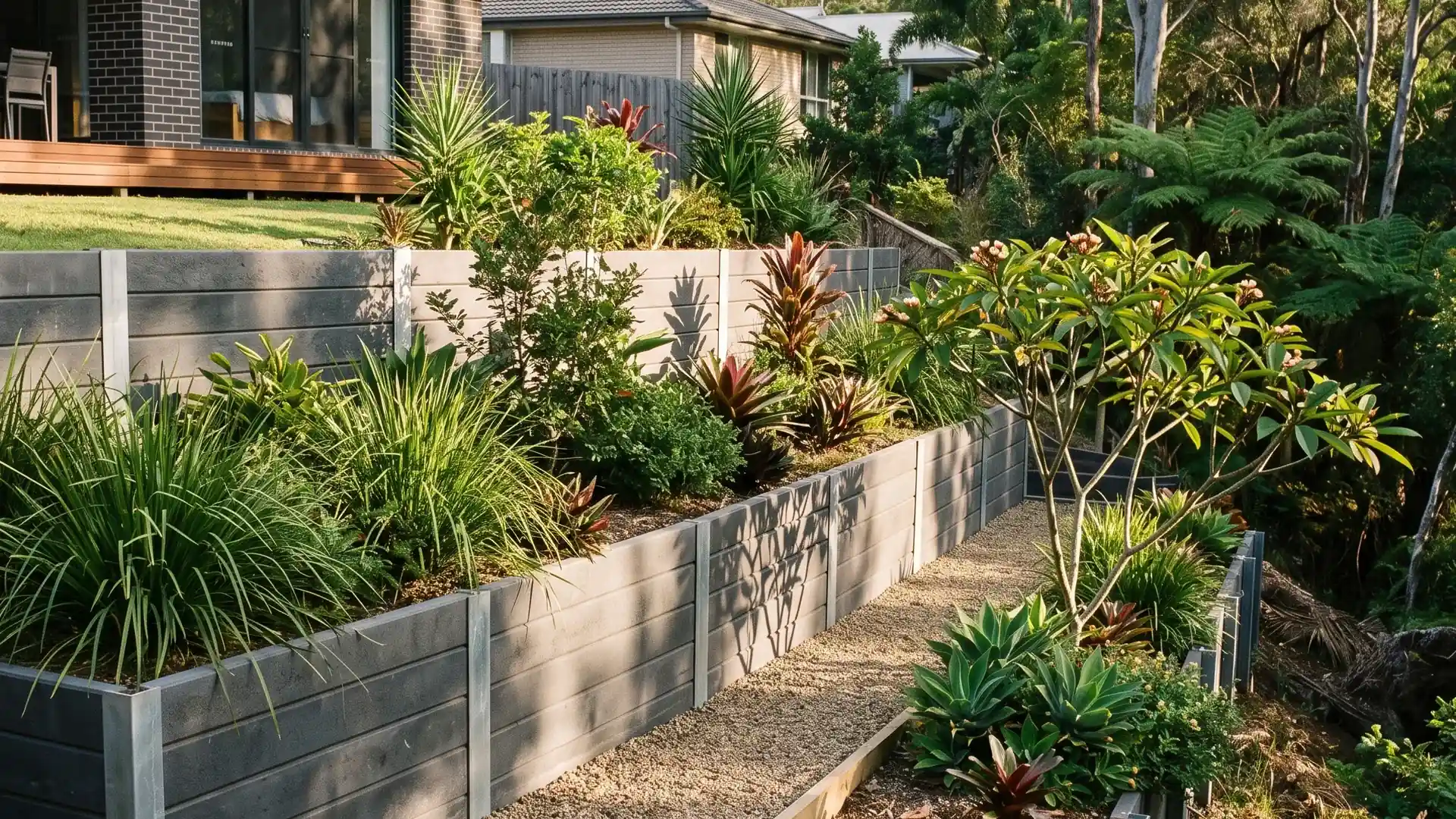
Most enquiries start with a fall the owner cannot use and a rough idea of a material. The useful order is the other way round: height, what sits above the wall, the ground and the drainage first, then the material. A concrete sleeper wall between galvanised posts suits most replacement work. A timber sleeper terrace still earns its place on a low garden fall. Core-filled besser block handles the tall, rendered and engineered jobs. A rock wall battered back into the slope suits acreage with room behind the face, and a gabion basket structure suits scour and surface runoff on erodible ground. Behind every one of them sits the same subsoil drainage requirement, and above the taller ones sits an engineered retaining wall pathway with AS 4678 design, Form 15 and Form 16.
Why people use us on a wall decision
QBCC-licensed specialists
Retaining wall work across the Sunshine Coast is carried out by licensed contractors in our network. Licensing is triggered by the value of the work, not the height of the wall.
Council approval understood upfront
Sunshine Coast Council requires a building permit before construction, modification or repair of most retaining walls, and its own approval as a concurrence agency for walls over 2 metres. We work that out with you before anything is quoted.
Drainage treated as structural
Subsoil drainage behind the wall is a requirement, not a finishing touch. Poor drainage is the leading cause of wall failure, so ag drain, aggregate and geofabric are part of every scope we discuss.
Built for Sunshine Coast ground
Blackall Range basalt clay, Buderim volcanic soil, Landsborough sandstone and coastal dune sand each behave differently. The right wall for a Maleny slope is not the right wall for a Peregian Springs sand ridge.
Which trade do you actually need?
People ask for a bricklayer, a landscaper, a mason or someone with an excavator for the same job. The line that matters is not the trade name: QBCC licensing is triggered by the value of the building work, not by the height of the wall. Structural retaining walls are Class 10b structures designed to AS 4678, and an engineered wall is typically certified by an RPEQ via Form 15 for the design and Form 16 on inspection. The specialists in our network hold the licence and carry out the work.
Retaining wall cost per metre, and what really moves it
Walls are priced by square metre of wall face, which is height multiplied by length. A wall 1.2 metres high and 10 metres long is 12 square metres of face, not 10 metres of wall. Indicative bands run from around $150 to $300 per square metre for rock and boulder walls, $300 to $450 for timber sleepers, $250 to $430 for gabion, $550 to $700 for concrete sleepers and $550 to $750 for core-filled block.
Indicative only. Those bands exclude GST, excavation, drainage, imported backfill, engineering and certification, demolition and disposal of an existing wall, and any premium for difficult access. Two quotes with the same square metre rate can be thousands apart on the exclusions alone, which is why it is worth asking for each of them as its own line.
Open the cost calculatorFour kinds of ground across Sunshine Coast
The Blackall Range plateau at Maleny and Montville sits on deep basalt-derived red clay at 400 to 560 metres with very high rainfall. The Buderim volcanic remnant rises to about 180 metres with steep escarpment margins. The weathered sandstone lowlands around Landsborough and Beerwah give sandy, erodible surface soils. The coastal sand plain and estuarine flats at Maroochydore, Mooloolaba, Coolum Beach, Peregian Springs and Bli Bli are about soft foundations and saturation rather than slope.
Common questions before you commit to anything
The four that come up most often, answered against what Sunshine Coast Regional Council and the Queensland requirements actually say.
Do I need council approval for a retaining wall on the Sunshine Coast?
How high can a retaining wall be without a permit in Queensland?
How much does a retaining wall cost per metre on the Sunshine Coast?
Do retaining walls need drainage behind them?
Talk to a retaining walls specialist
Know what your block and your council require before you spend
Send the height, the length, what sits above the wall and your suburb, and we will help you take the next step.