Timber Sleeper Retaining Walls Sunshine Coast
H4 treated pine and hardwood sleeper walls for garden terraces, step-downs and low boundary retaining. We will tell you honestly where timber still makes sense on this coast and where it will cost you twice.
Where a timber sleeper wall is still the right call
Timber is the cheapest way to hold ground and the shortest-lived. That trade is fine when the wall is a low garden terrace, a raised bed edge or a step-down through a sloping backyard, and it is a poor trade when the wall is holding a driveway or a house platform.
H4 treated pine is rated for in-ground use and resists rot and termite attack. What it does not do is stop water sitting against the timber for years, and constant moisture is what actually ends these walls in a humid subtropical climate.
Who this is for
Two readers land here. The first wants a terraced garden, a level lawn area cut into a gentle fall, or an edge along a path, and is working to a budget. The second is looking at a pine wall that has gone soft at the base and is deciding whether to do it again in timber or upgrade.
For the first, timber is often exactly right and a stepped series of low terraces will usually suit the fall better than one taller wall. For the second, the answer depends on why the first wall failed. If the posts rotted at ground line and the ground behind stayed wet, a second timber wall in the same place with the same drainage will do the same thing.
What a timber sleeper job covers
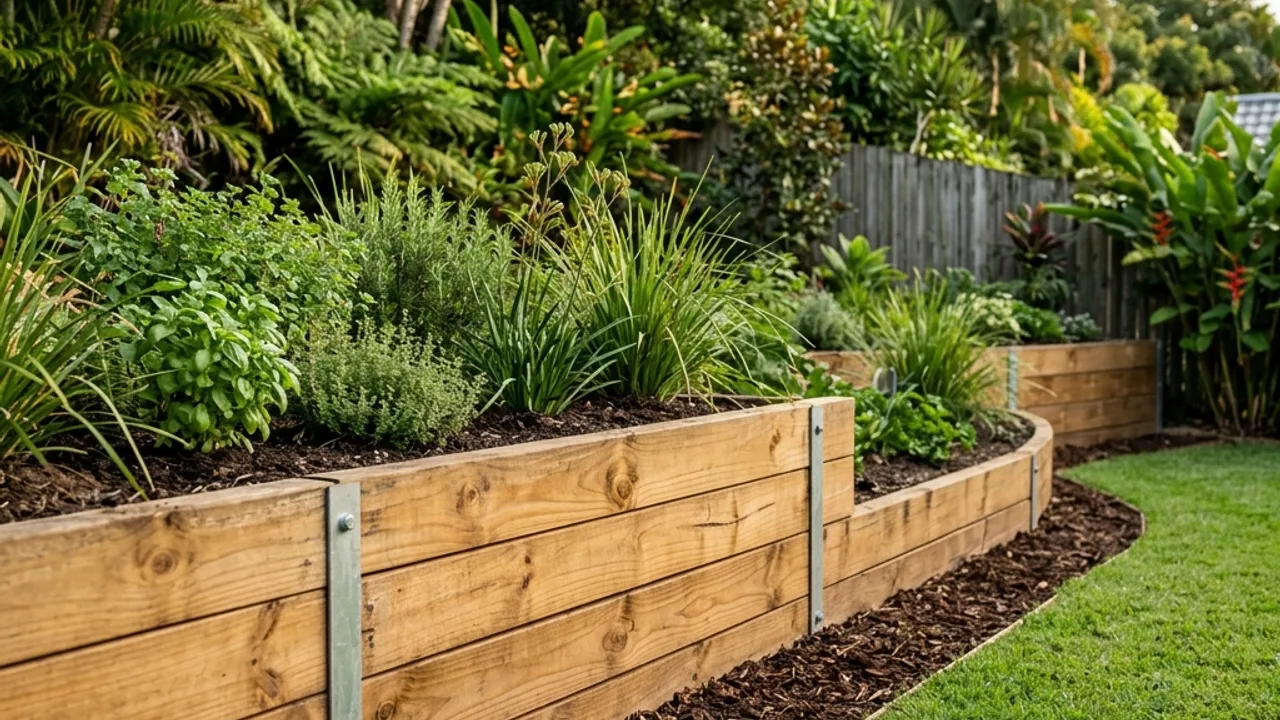
H4 treated pine sleeper walls
Treated to a rating intended for in-ground use, resisting rot and termites. The standard choice for garden-scale retaining where cost matters.
Hardwood sleeper walls
Denser and longer-lived than softwood, and more expensive. Worth it where the wall is visible from the house or where the extra durability is the point.
Galvanised or timber post systems
Galvanised steel posts with timber infill outlast an all-timber wall because the post, not the sleeper, is the part that fails first. It changes the look and it changes the life.
Garden terracing and step-downs
Two or three low walls stepped back up a slope, with planting between them, rather than one wall doing all the work. Lower walls, less load, and usually a better result on a gentle fall.
Drainage and free-draining backfill
Gravel behind the sleepers and an ag drain at the base, separated from the soil with geofabric so the gravel does not silt up. This is the single change that most extends a timber wall's life.
How a timber terrace gets built
- 1
Describe the fall
How much drop you are dealing with over what distance, and what you want the finished ground to do. One tall wall and three low terraces solve very different problems.
- 2
Check the exemption test honestly
The council's position is that a permit is required before construction, modification or repair of most retaining walls. The state exemption conditions explain why a wall might be exempt, and all of them have to be met, not just the height one.
- 3
Set the post system
Post material, spacing and depth are chosen for the retained height and the ground moisture. In shaded, damp corners of a block the post detail matters more than the sleeper choice.
- 4
Backfill with gravel, not spoil
The temptation on a small job is to push the excavated clay straight back in. That is what holds water against the timber. Free-draining backfill and a base drain cost a little and buy years.
What actually decides how long a timber wall lasts
Moisture is first. A wall in a shaded, low corner where water collects will go long before the same wall on an open, well-drained slope. Timber that dries between wettings survives; timber that never dries does not.
Post embedment is second. Timber walls almost always fail at the posts, at ground line, where the wet and dry cycles are worst. Depth, concrete and drainage around the post are what buy time.
Retained height including fill is third. If the finished ground behind the wall is higher than the natural ground, the retained height is measured from the bottom of the face to the new top, not to the old one.
Anything sitting above the wall is fourth and it is a stop sign, not a factor. If a driveway, a shed, a pool or another wall sits inside the zone of influence behind a timber wall, this stops being a garden project. Read the engineered walls page before going further.
Indicative cost for timber sleeper walls
$300 - $450 per square metre of wall face
Indicative only
Indicative only. Timber sleeper walls run around $300 to $450 per square metre of wall face, which is the cheapest of the structural options and the reason it is the default for garden work.
Excluded from that band: GST, excavation, drainage and gravel backfill, imported fill, engineering where the wall needs it, disposal of an old wall, and access difficulty. A quote that lands under the band is usually a quote with the drainage left out, so ask for it as its own line before comparing.
Why use our team for a timber wall
We will talk you out of timber when it is wrong
If the wall is holding a driveway or is going to end up over head height, saying so is more useful than quoting it. That conversation costs you nothing and saves the second build.
The stepped-terrace option gets raised early
Plenty of falls that get quoted as one 1.4 metre wall are better as two 700 millimetre terraces. Lower walls, simpler approval position, and usually a nicer garden.
Drainage is quoted, not assumed
The cheapest way to make a timber wall look competitive is to leave the gravel and the ag drain out. We treat subsoil drainage as part of the wall, because QDC NMP 1.7 does too.
The three questions we get most
Will it just rot out again?
It depends entirely on water and post detail. H4 treatment resists rot and termites; it does not make timber waterproof. Walls that fail early are almost always walls with no drainage behind them and shallow posts in ground that stays wet. Fix those two and a treated pine wall does its job for a long time. Treated softwood sleeper walls in coastal Queensland conditions are commonly cited at around 10 to 15 years before major repair or replacement.
Can I build a low garden wall myself?
Low, non-structural garden walls are commonly owner-built. Be careful with two things. Licensing follows the value of the building work rather than the height of the wall, so a bigger job can be licensed work even at low height. And the exemption conditions have several parts, so a low wall is not automatically outside approval.
Is a small wall exempt from council approval?
Not automatically. Sunshine Coast Regional Council states a building permit is required before construction, modification or repair of most retaining walls. The Queensland exemption conditions are the test that explains why a particular wall might sit outside that: total height no more than 1.0 metre, no surcharge in the zone of influence, at least 1.5 metres from a building or another retaining wall, not part of a pool barrier, and wall plus fence under 2.0 metres. All of them, or none.
Timber walls in a subtropical climate
Coastal humidity, heavy summer rainfall and shaded subtropical planting are the working conditions for timber here, and they are harder on a sleeper wall than a dry inland site would be. Garden terracing is common on the smaller lots at Sippy Downs, Mountain Creek, Bli Bli and Palmwoods, and timber suits most of it.
Up on the Blackall Range at Maleny and Montville the case for timber narrows quickly. Sustained wet ground and very high annual rainfall mean anything holding real load is better in concrete or block, and what timber is left up there is usually terracing inside a garden rather than the wall doing the structural work.
Related pages
- concrete sleeper walls - the usual upgrade when a pine wall reaches the end of its life
- retaining wall repairs - if the existing wall may only need a section replaced
- subsoil drainage - the detail that decides how long timber survives here
Timber Sleeper Retaining Walls: questions we get asked
How long do timber sleeper retaining walls last on the Sunshine Coast?
Can I repair my old timber retaining wall or do I need to replace it?
Is timber or concrete better for retaining walls on the Sunshine Coast?
Do I need a building certifier for a small garden retaining wall at my Sunshine Coast home?
Can I build my own retaining wall or do I need a licensed builder in Queensland?
Timber Sleeper Retaining Walls across Sunshine Coast
The ground changes across the coast, and so does the right approach to timber sleeper retaining walls. Open your suburb for the local conditions and the approval questions that come with them.
Talk to a retaining walls specialist
Ask about your timber wall
Everything above applies to timber sleeper retaining walls across the Sunshine Coast. Send your details and we will help you get in front of a licensed specialist.