Rock And Boulder Retaining Walls Sunshine Coast
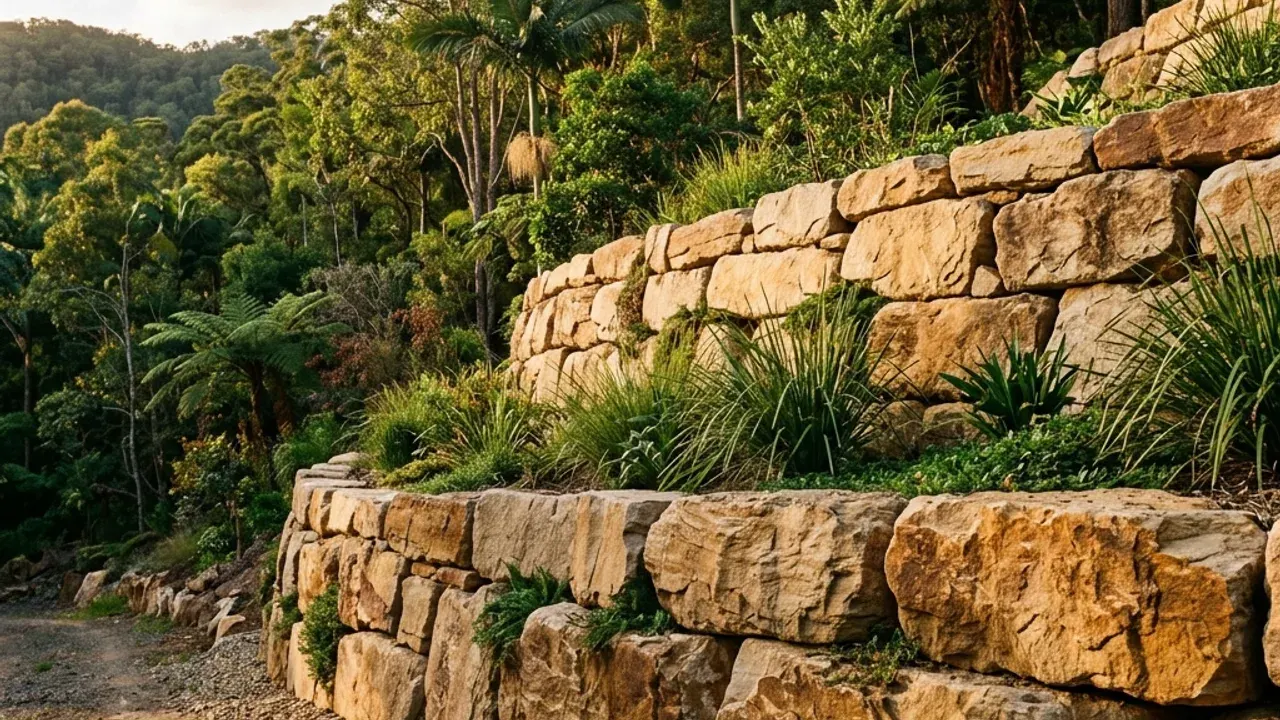
Natural sandstone and boulder walls battered back into the slope, free-draining by construction and suited to acreage, driveway cuts and hinterland falls. The wall looks like it belongs on the site rather than like a product bolted onto it.
What decides whether a rock wall suits your block
A rock wall is large natural stones placed and stacked with a batter, meaning the face leans back into the slope rather than standing vertical. That lean is what makes the wall work, and it is also what makes it unsuitable on a block with no room behind the face.
Rock is the cheapest of the structural options per square metre of face and the most site-dependent. Two walls of the same height on two different blocks can be very different jobs once batter room, machine access and stone cartage are in the picture.
Who this is for
This page is for acreage, rural-residential and larger sloping blocks: a long driveway batter, a house cut on falling land, a dam or creek edge, or a terraced fall through a big garden. The reader usually cares how it looks as much as what it does, and wants the wall to read as part of the landscape.
The first conversation is about room and access rather than height. How much space is available behind the face for the batter, whether a large excavator can reach the work, and where stone can be delivered and stockpiled. Those three answers decide whether a rock wall is even the right recommendation before anything is priced.
What a rock wall job involves
Boulder and sandstone wall construction
Stone placed by machine, keyed into the slope, sized down as the wall rises so the heavy material sits at the base where the load is.
Battered faces and terracing
The face set back at an angle suited to the ground. Where one tall wall would need too much batter, two or three terraces up the slope usually work better and look better.
Base preparation
A prepared, bearing base under the first course. Rock walls carry point loads rather than a spread load, so what the bottom stones sit on decides whether the face stays true.
Free-draining backfill
Aggregate behind the face so water moves through the wall rather than building pressure against it, with geofabric keeping the soil out of the drainage layer.
Driveway and dam batters
Cut faces along driveways and around water edges, where the wall is holding a working surface and erosion control matters as much as retention.
How a rock wall job is set up
- 1
Assess room and access
How much space sits behind the face for the batter, and whether a large machine and stone truck can get to the work. This is the first filter, and it settles more rock wall enquiries than height does.
- 2
Read the slope
Long falls on hinterland blocks often want a terraced series rather than one wall. Where the site sits inside the Landslide Hazard and Steep Land Overlay, a slope-stability assessment applies, and steep land there is defined as slopes of 15 per cent or greater.
- 3
Select the stone
Stone type and size follow the height, the look and what is available. Bigger stone means fewer joints and a stronger base, and it also means a bigger machine.
- 4
Place, backfill, batter
Base course keyed in, stone placed and locked, aggregate backfill brought up with the wall, and the face battered consistently so it reads as one wall rather than a pile.
Batter, access and what the ground will carry
Batter room is the first constraint and there is no way around it. A rock wall needs to lean back, and the taller it is the more ground behind the face it consumes. On a small coastal lot that space simply is not there, which is why rock walls are rare at Mooloolaba and common at Maleny.
Machine access is the second. Stone is placed by excavator, not by hand, and the machine has to reach the whole run. A wall at the bottom of a steep block with no side access is a different job, sometimes an impossible one.
Stone supply and cartage is the third. Cartage distance and stone size move the number more than face area does on a smaller job, and the exclusions are where that difference lives rather than in the headline rate.
Surcharge applies here exactly as it does to a vertical wall. The approval triggers follow height, load, proximity and pool barriers, not how natural the wall looks. A rock wall holding a driveway is a wall carrying a surcharge load.
Indicative cost for rock and boulder walls
$150 - $300 per square metre of wall face
Indicative only
Indicative only. Rock and boulder walls sit around $150 to $300 per square metre of wall face, the lowest of the structural options on face area alone.
The headline rate flatters the job, so read the exclusions carefully: GST, excavation and cut-to-fill earthworks, drainage, backfill aggregate, engineering where required, stone cartage, and difficult access. On a constrained site those exclusions can outweigh the face-area saving entirely.
Why use our team for a rock wall
Site suitability is assessed before material
We ask about room behind the face and machine access first, because a rock wall recommended onto a site that cannot take one is the most expensive kind of wrong answer.
Terracing is offered where one wall does not suit
Long hinterland falls often work better as two or three stepped walls. Raising that early changes the earthworks plan while it is still cheap to change.
Slope questions go to the right people
On steep hinterland ground, stability is assessed by qualified people, and sites inside the Landslide Hazard and Steep Land Overlay require a slope-stability assessment. We help you understand when that applies rather than guessing at it.
The three questions we get most
Rock looks cheaper. Is it actually?
Per square metre of face, usually yes. On the finished job, it depends on the site. Batter room, machine access and stone cartage are the swing factors, and all three sit outside the face-area rate. On a big open block with good access rock is genuinely economical. On a tight site with a long carry it is not.
Does a rock wall need approval? It is just stone.
The approval triggers do not care what the wall is made of. Height, surcharge load, proximity to a building or another wall, and pool barrier status are what count, and Sunshine Coast Regional Council states a permit is required before construction, modification or repair of most retaining walls. Over 2 metres, council concurrence applies as well.
Will it hold on my slope?
On steep hinterland ground the honest answer is that slope stability is a question for assessment rather than for a rule of thumb. The Sunshine Coast Planning Scheme 2014 maps a Landslide Hazard and Steep Land Overlay and defines steep land as slopes of 15 per cent or greater, with a slope-stability assessment required for sites in the overlay. If your block is on the range or the escarpment, expect that question to come up early.
Rock walls on hinterland and acreage blocks
Rock and boulder walls suit the hinterland and rural-residential country around Maleny, Montville, Landsborough, Beerwah and the Palmwoods hills, where the falls are long, the blocks are big and there is room to batter back properly. On those sites a stone wall reads as part of the landform rather than as a structure imposed on it.
Around Landsborough and Beerwah the weathered sandstone gives sandy, erodible surface soils, so a rock wall there has to control scour and surface runoff as well as hold ground. It is rarely the right answer on the small coastal-plain lots at Mooloolaba, Maroochydore or Coolum Beach, where there is no room behind the face and a vertical wall is the only option that fits.
Related pages
- gabion walls - where the same free-draining logic is wanted in a tighter footprint
- besser block walls - when a vertical engineered face is the only thing that fits
- engineered and council-approved walls - for the overlay and slope assessment questions
Rock & Boulder Retaining Walls: questions we get asked
Are there special rules for retaining walls in the Sunshine Coast hinterland like Maleny and Montville?
How much does it typically cost to build a retaining wall in Queensland?
What setbacks apply for retaining walls from side boundaries?
How long does it take to build a retaining wall at a residential property?
Can I build my own retaining wall or do I need a licensed builder in Queensland?
Rock & Boulder Retaining Walls across Sunshine Coast
The ground changes across the coast, and so does the right approach to rock & boulder retaining walls. Open your suburb for the local conditions and the approval questions that come with them.
Talk to a retaining walls specialist
Ask about a rock wall for your block
Everything above applies to rock & boulder retaining walls across the Sunshine Coast. Send your details and we will help you get in front of a licensed specialist.